Object details
| Designer / Studio | Albert Ko, Adrian Lo; team: Nicole Lee, Mahir Taher, Martin Cheung, Bob Yu, Fish Chiu |
| Organisation | UNU HIT Hub at Lingnan University, Hong Kong |
| Award | EPDA 2026 Design for Humanity; Top Design, Industrial / Healthcare: Medical Products |
| Explore the design | ln.edu.hk/incuvia |
An incubator is usually a fixed piece of hospital furniture. It assumes a stable room, a reliable socket and staff who already know where it lives.
Incuvia starts from the opposite situation. Designed by Albert Ko and Adrian Lo at the UNU HIT Hub at Lingnan University, it was shaped by field research in the Philippines, in regions far from the grid and from specialist care. It received the Design for Humanity prize at the 2026 European Product Design Award.
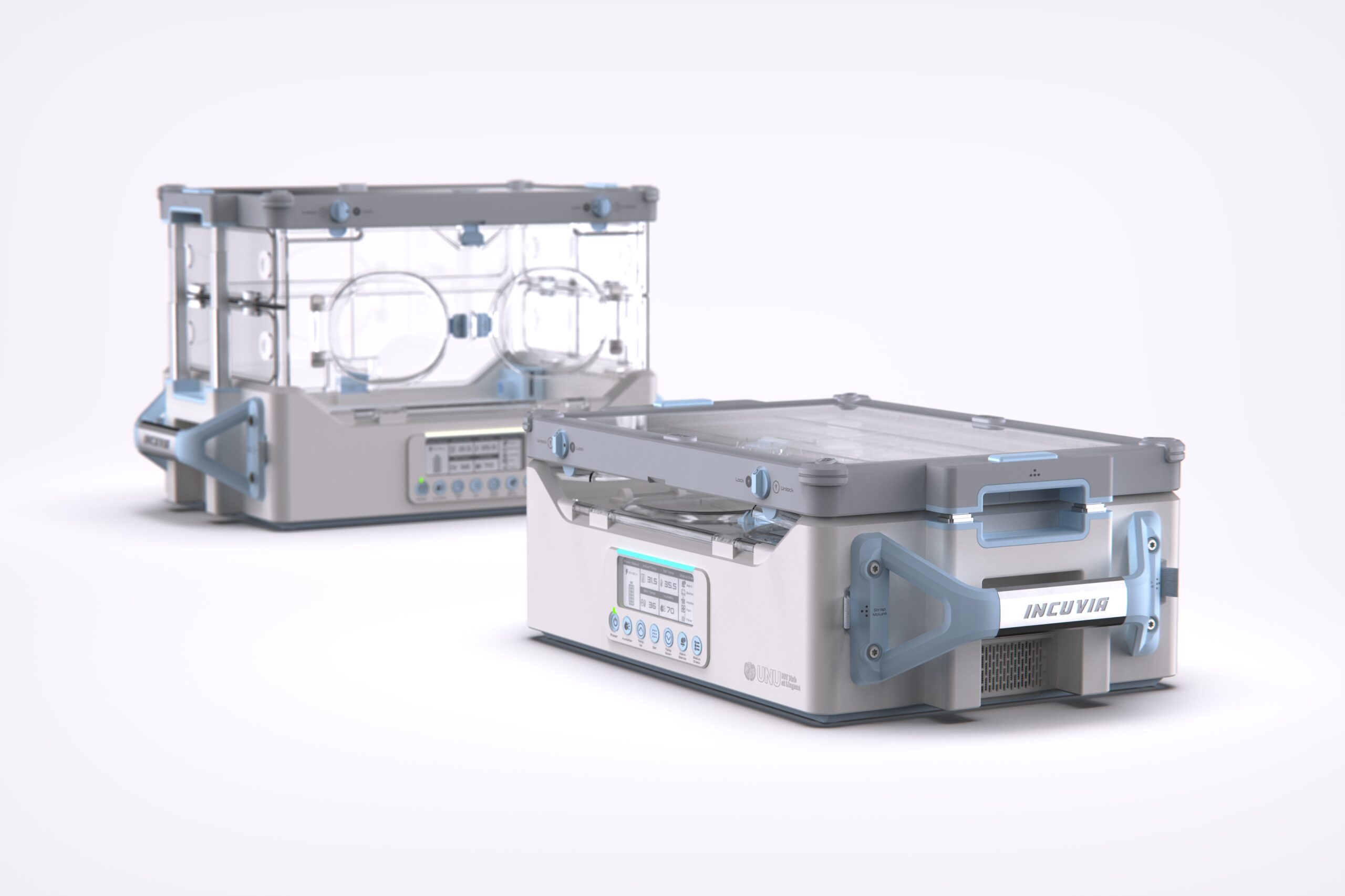
The central move is a telescopic folding structure. Closed, the incubator travels as a case. Opened on arrival, it extends into an active care station. The same object handles the journey and the ward, so nothing has to be assembled from loose parts at the bedside.
Power is treated with the same realism. The system can run from solar sources and carries a four-hour internal battery as backup, which matters where supply is intermittent rather than absent.
The interface is an anti-glare E-ink screen. It is a modest choice, but a telling one: readable in bright daylight, low in power draw, and calm in a setting where a clinician’s attention is already stretched.
What makes Incuvia persuasive is that its form follows its logistics. The folding, the battery and the screen all answer the same question: how does care arrive, and how does it keep working once it does?
View Incuvia on the European Product Design Award winner’s page →
Image: UNU HIT Hub at Lingnan University. Render and photo by Adrian Lo.