Object details
| Designer / Studio | Yong Zheng; team: Caijin Chen, Kaihuang Chen, Tao Xu, Chaozheng He, Dong Wu, Jiatao Ma |
| Brand | Galbot, China |
| Key figures | 50 kg payload, 2,400 mm reach, 8-hour runtime, automatic battery swapping |
| Award | EPDA 2026 Product Design of the Year; Top Design, Industrial / Tools: Powered Tools & Equipment |
Industrial robots have long been designed for cages. Kept apart from people, they had no need to communicate, only to perform.
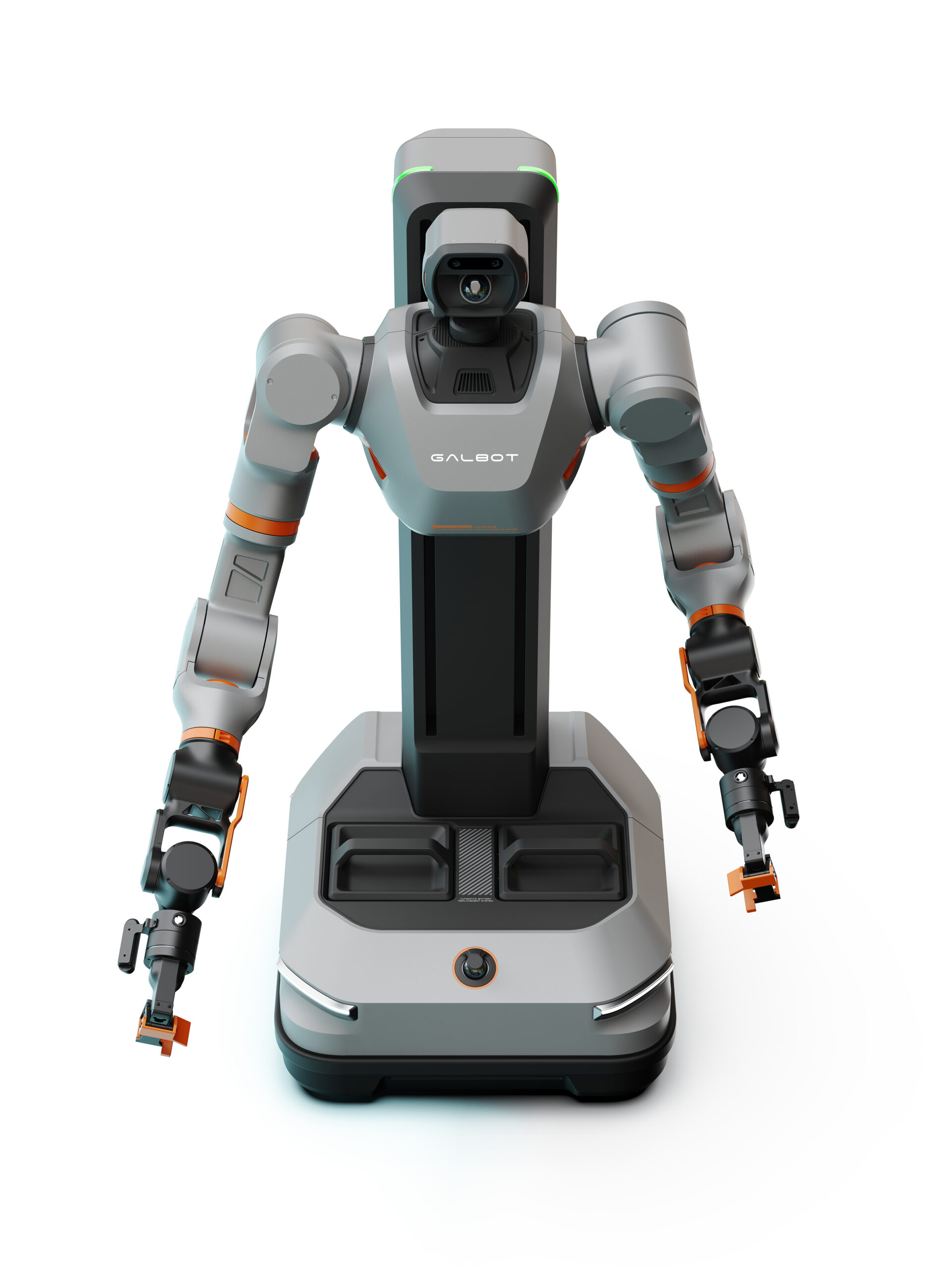
GALBOT S1, designed by Yong Zheng and his team at Galbot, is built for a different setting: factories and warehouses where machines and people increasingly share the floor. The robot was named Product Design of the Year at the 2026 European Product Design Award.
Its capabilities are substantial. S1 carries payloads up to 50 kg, reaches 2,400 mm, and runs for eight hours, with automatic battery swapping so work need not stop to recharge. A seven-degree-of-freedom, three-finger gripper adapts to different objects, from bin picking to palletising and depalletising heavy loads.
The design work lies in how that capability is presented. A pan-tilt head, angled shoulders and a compact torso give the robot a recognisable stance, while an omnidirectional base with four-wheel steering lets it move in tight aisles. Panoramic perception helps it read the space around it.
Most telling is the perimeter lighting, which signals safety and motion status. It is a simple layer of communication that lets the people nearby understand what the machine is about to do.
As robots leave their cages, their form becomes a kind of language. GALBOT S1 suggests that being legible to people is now part of being useful.
View GALBOT S1 on the European Product Design Award winner’s page →
Image: Galbot.